
Adaptation pathways for coastal archetypes (T3.4)
Mid-2026
Part of the FUTURISKS team is back in French Polynesian atolls of Anaa and Rangiroa to make progress on the co-design of adaptation trajectories to climate change, and in particular to sea level rise, by 2100. This mission follows the work undertaken in May and November 2025 during which we conducted a series of interviews with stakeholders in the municipalities of Rangiroa and Anaa, and also with the populations. On this basis, the current mission aims to present draft adaptation trajectories, to debate them in order to identify which trajectories seem most relevant in the eyes of the actors (desirability), and what their conditions of implementation would be (feasibility).
The team will also make the link with the Territory, in particular through its Climate Plan, in which the question of adaptation trajectories is central. A working meeting is planned with the two pilots of the Climate Plan (Ministries of Energy and the Environment) and the “coastal strategy” technical advisor in charge of development and the “coastal strategy” (Ministry of Land and Housing in charge of development).
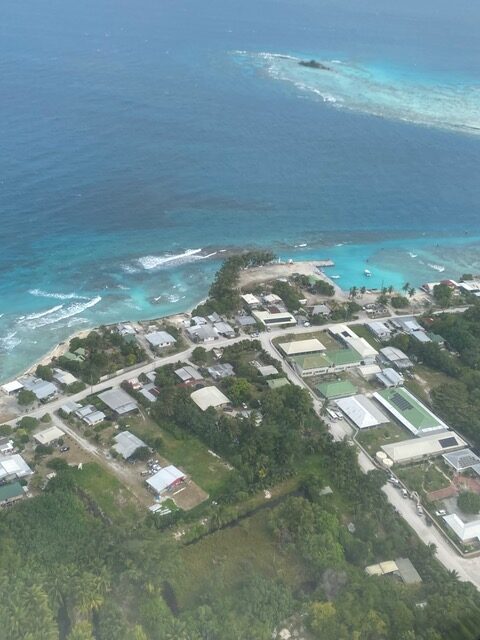
Aerial view of the Rangiroa administrative center (© Alexandre MAGNAN, 2026)
2025
As global warming is intensifying, science warms against the potential shrinking of the range of available options for climate adaptation. But to what extent is such a conclusion evidence-based? And what influence do local context-specificities have on such a gloomy assertion? Task T3.4 on “Adaptation pathways for coastal archetypes” addresses these questions.
Task T3.4 develops an innovative Structured Expert Judgment (SEJ) method to assess the future of the solution space for climate adaptation in atoll islands (Fig. 1). The work is two-fold.
- First, it consists of a group of 15 international scientists with decades of experience in atolls of the Pacific and Indian oceans that will assess the potential effectiveness of twenty types of measures to minimise future climate risks, and ranging from engineered and nature-based coastal protection and accommodation, to internal and international relocation. This assessment will consider 4 atoll island types (small rural islands, large rural islands, urban islands moderately populated, urban islands densely populated), 4 assessment criteria (potential risk reduction, readiness for implementation, lead time until full benefits, duration of benefits), 4 climate scenarios (+1.5/2°C, +3°C, +’;’°C and beyond 5°C) and 2 adaptation scenarios (low vs. high).
- Second, T3.4 will implement a lighter method to develop adaptation pathways for several islands, starting with Rangiroa and Anaa atolls in French Polynesia. This work will encompass the characterisation of climate risks and the panel of adaptation options for the two case studies, followed by a series of participatory workshops with local experts (i.e. representatives from authorities and the population). The landing point will be the co-design of long-term adaptation strategies.
Roadmap 2026-2027:
- Scientific assessment by end 2026
- Rangiroa and Anaa atolls adaptation pathways by end-2026/mid-2027
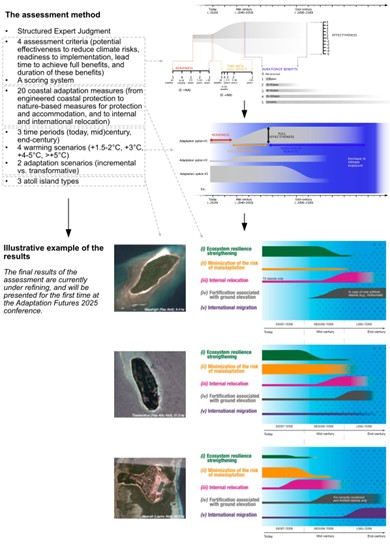
Overview of the scientific approach